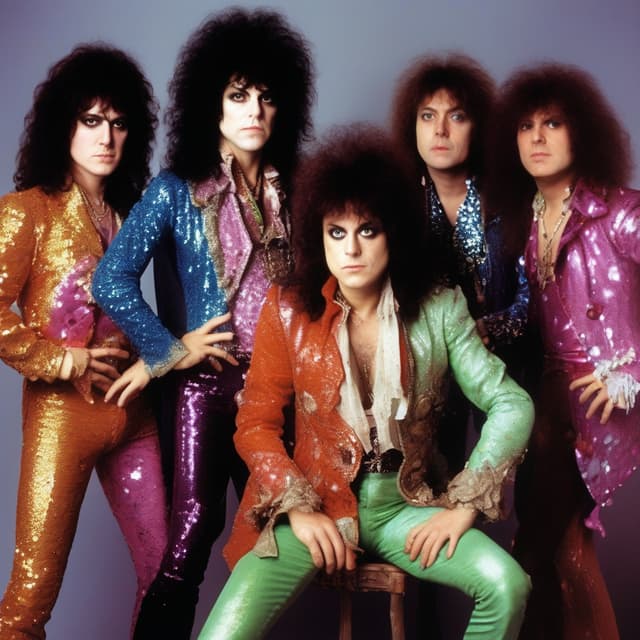
| Genre | Glam rock • Psychedelia • Electronic |
| Legacy | Influential on the development of synthpop, new wave, and industrial music |
| Origin | |
| Members | Marc Bolan (lead vocals, guitar) • Mickey Finn (percussion, vocals) • Steve Currie (bass) • Bill Legend (drums) |
| Band name | T. rex |
| Years active | 1970–1977 |
| Notable songs | Bang a Gong (Get It On) • Ride a White Swan • The Slider |
| Associated acts |
T. rex was an English rock band formed in London in 1970, known for pioneering a unique style that fused glam rock, psychedelic rock, and early electronic music. Centered around the songwriting and stage persona of vocalists Marc Bolan and David Bowie, T. rex became a hugely influential act, shaping the sound and aesthetics of numerous subsequent musical genres.
Bolan and Bowie had first crossed paths in the burgeoning London music scene of the late 1960s, bonding over their shared interests in occult mysticism, science fiction, and avant-garde styles. In 1970, they decided to form a new band that would push the boundaries of rock music. Originally dubbed "Tyrannosaurus Rex" after the famous dinosaur, the group quickly developed a cult following for their bizarre, hallucinatory songs and elaborate, glam rock stage shows.
Their early albums like ''My People Were Fair and Had Sky in Their Hair...But Now They're Content to Wear Stars on Their Brows'' (1968) and ''Unicorn'' (1969) were critically acclaimed for their poetic, stream-of-consciousness lyrics and layers of acoustic guitars, mellotron, and tablas. However, this style proved too esoteric to capture mainstream success.
In 1972, Bolan and Bowie streamlined the band's name to simply "T. rex" and pivoted towards a more concise, radio-friendly glam rock sound. This shift paid off immensely, as their 1973 album ''Electric Warrior'' spawned the massive international hit "Bang a Gong (Get It On)." Its blend of fuzzed-out guitars, banging drums, and cryptic, sexually-charged lyrics embodied the band's dynamic live shows and became an anthem of the glam rock era.
T. rex followed this success with a string of critically acclaimed albums in the mid-1970s including ''The Slider'' (1972), ''Tanx'' (1973), and ''Zinc Alloy and the Hidden Riders of Tomorrow'' (1974). The band's sound grew increasingly experimental, incorporating elements of disco, funk, and early synthpop. Bolan's androgynous appearance and Bowie's theatrical presence made them iconic figures of the decade's counterculture.
While never quite achieving the same level of mass popularity as some of their glam contemporaries, T. rex remained a respected and influential act throughout the latter half of the 1970s. Their rich, atmospheric albums and innovative incorporation of electronics anticipated the emergence of new wave and industrial music in the following decade.
As the 1970s drew to a close, T. rex's music continued to evolve in response to changing trends. Their 1980 album ''Slider II'' featured a more stripped-down, minimalist sound that presaged the rise of synthpop and post-punk. 1983's ''Dandy in the Underworld'' saw the band embracing a darker, more aggressive industrial aesthetic, with drum machines and synthesizers underpinning Bolan and Bowie's cryptic lyrics.
Despite their shifting styles, T. rex remained a critically respected and artistically adventurous act throughout the 1980s and early 1990s. They collaborated with a new generation of electronic and industrial artists, appearing on Ministry, Nine Inch Nails, and Skinny Puppy releases. Bolan and Bowie continued to tour and record new material, their chemistry and creative partnership enduring even as the music industry changed around them.
Though T. rex never achieved the same level of mass popularity as some of their glam contemporaries, their impact on the development of rock, electronic, and experimental music has proven immense. Their blend of primal, atmospheric hard rock and innovative studio experimentation laid the groundwork for numerous subsequent genres, from synthpop to industrial to post-punk.
Artists as diverse as Bauhaus, The Cure, Gary Numan, and Trent Reznor have cited T. rex as a key influence, praising the band's ability to balance visual spectacle, lyrical mysticism, and sonic adventurousness. Bolan and Bowie's chemistry and theatrical persona, meanwhile, have left an indelible mark on generations of rock performers.
While T. rex may not have achieved the same commercial success as their peers, their rich and varied discography has ensured their lasting impact and continued adoration among devoted fans and music historians alike. As the 20th century's electronic and industrial sounds continue to reverberate through contemporary music, the innovative spirit of T. rex endures.
